Progressive Difficulty
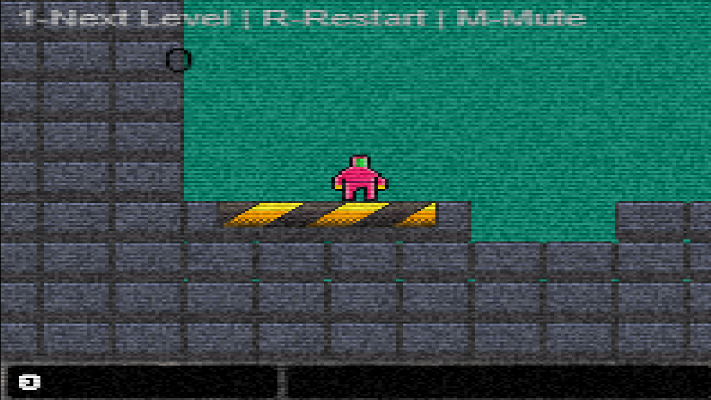
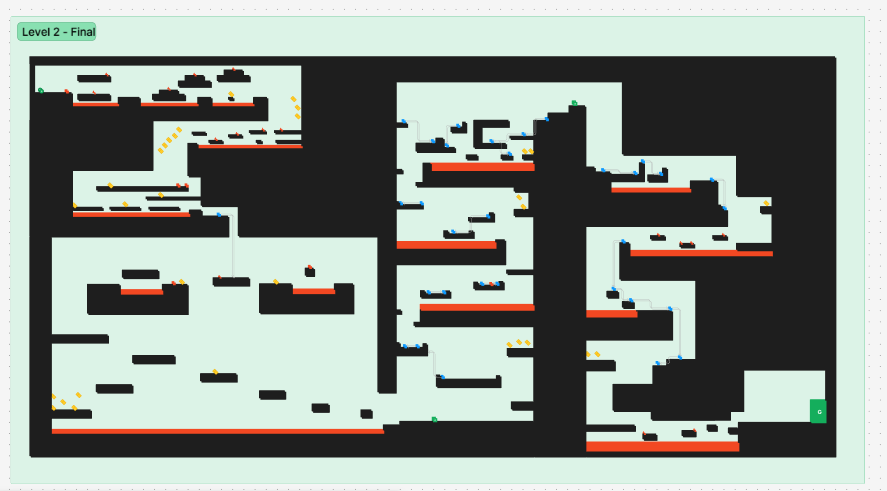
I designed the layouts for all 5 levels, each introducing one new mechanic before adding increasingly complex combinations with what came before. For example, level 2 is shown throughout this page and it centers on a tall branching shaft. The player picks a path upwards through separate platforming rooms, each with a coin trail marking the riskier optional route. Every level tells the player its mechanic from the start before asking them to apply it under tighter constraints as the level progresses.
What I Was Going For
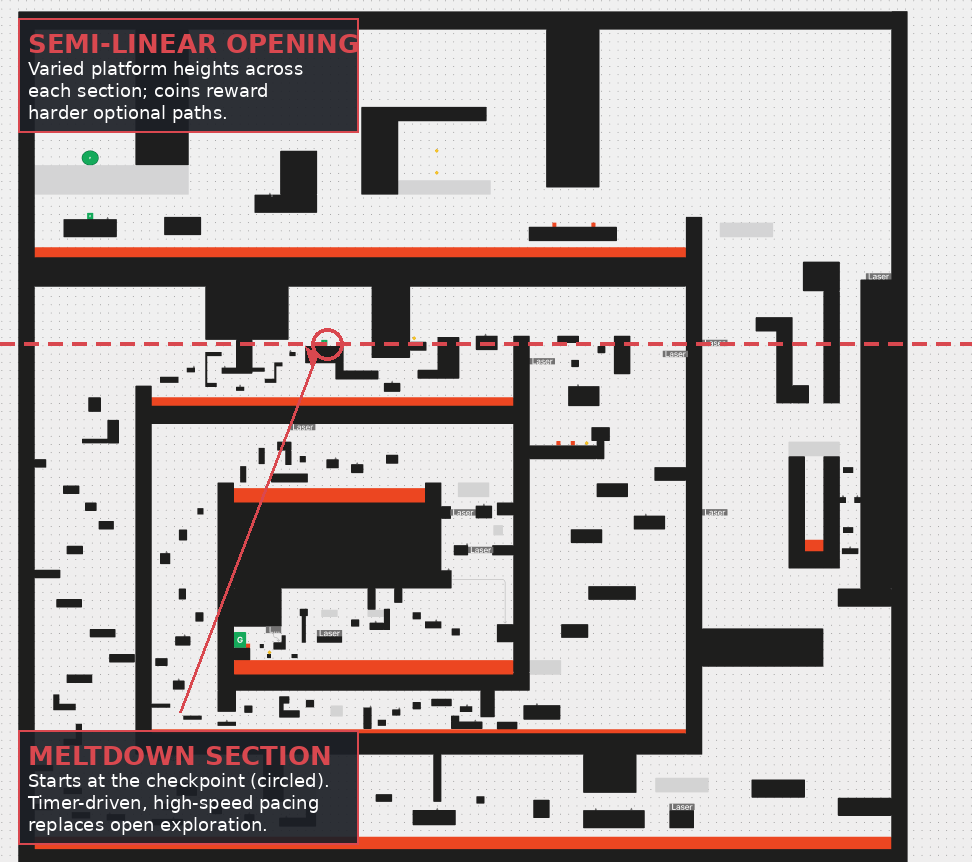
I was trying to create two different moods in the same level. The opening plays semi-linearly; the player moves through the branching shaft at their own pace with coin trails rewarding more precise platforming. Past the checkpoint, the level becomes a tighter hazard-lined loop and the mood flips. A timer starts and players rush into precise, high-speed platforming with no room to explore alternate routes. The shift from open branching paths to a closed timed loop is the core of the level's pacing.
How It Evolved
One important concept of the process is to make sure every component of this level has a purpose relative to the goals of the game. For example, we wanted to encourage repeated playthroughs due to this game being extremely short in length, but we also want to keep the verticality intact. While the game is a simple 2D platformer with the goal of reaching the end, it was important to keep linearity in vertical sections going upwards, while allowing for some freedom going down. Most often moving upwards requires precise, tight platforming while moving down necessitates speed. This same shift repeats across all 5 levels, and giving the player options without much time to think adds to the tension of the game.
What Didn't Work
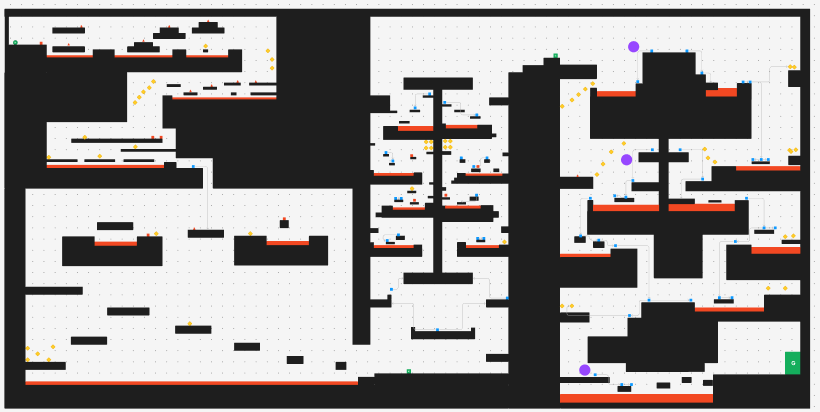
As mentioned earlier, one approach I tried was to have more nonlinear areas across the entire stage, rather than just before the meltdown section. I thought by giving the player more options when going up, it would encourage repeated playthroughs if players wanted to obtain every collectible. In addition, it would allow for more creative opportunities for the mechanics and puzzle solving, since the player could choose how they wanted to progress based on their current knowledge of the mechanics. However, we figured it would clash too much with the goals of the game. When trying to balance precision based platforming with more slow paced puzzle platforming, we needed the proper separation to take place in order to accomplish the goal.
The Finished Space
The finished product is 5 levels, each introducing a simple mechanic before expanding on it in new ways, requiring the player to adjust. The shift from open, nonlinear exploration to tighter, linear pacing carry through the rest of the game, most visibly when the pacing shifts after the "meltdown".
What I'd Do Differently Now
I would make sure I am more familiar with the precision of the character before starting this project again. In the past, I learned about movement in level design through units of measurement, which could be best used to communicate certain distances a character can move. (For example, if a character's jump was one tile high, this could be my measurement of choice). This would make it easier for me to explain exactly how each section is supposed to work, walking through the level step by step from the perspective of the player.